Savvy V2
A decision-support layer that ranks by lock-in risk
Savvy is a decision-support layer for wholesale B2B operations. It surfaces the decisions that need intervention before delay becomes loss.


Project type
Self-directed case study
Role
Product Designer, end-to-end
Tools
Figma
Claude
Duration
12 weeks
Summary
Savvy is a decision-support layer for wholesale B2B operations. It surfaces the few decisions that will cost you if you wait, and pushes everything else out of view.
In these operations, losses rarely come from wrong decisions. They come from late ones. The information exists, but it's scattered across too many tools, and nothing signals what needs attention right now. Savvy makes one question, "what needs me today?", the first thing you see instead of something you have to go looking for.
01 THE PROBLEM
Where the losses actually come from
B2B operations don't fail from a lack of information. They fail when decisions happen too late. The information already existed. The problem was catching the moment a decision needed intervention before the delay became expensive. That moment belongs to the deal owner, accountable for revenue and dependent on every team around them.

02 THE REFRAME
The principle I designed around
Most tools answer this with more dashboards and more data. I decided that was the wrong read. This isn't an information problem, it's an attention problem.
So I set one rule for every screen. Don't organize the work, reorganize the attention. Each screen had to answer a single question.

03 THE PRODUCT DECISIONS
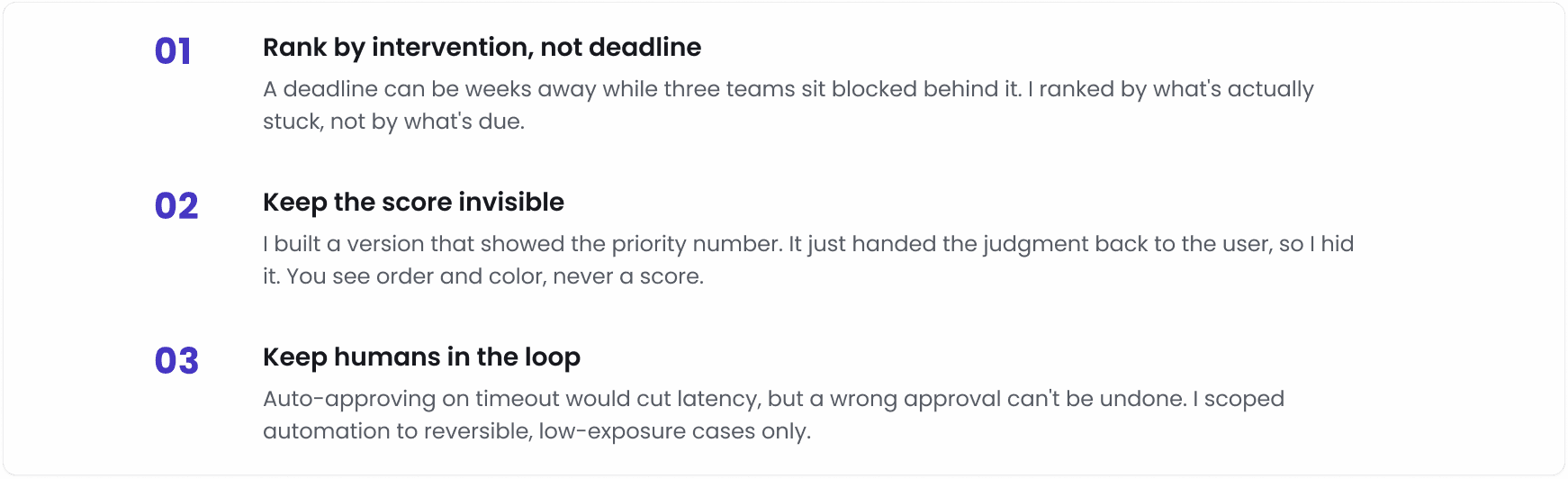
The three decisions that define Savvy
Everything else on the screen follows from these three calls.

HOW I USED AI
Before asking AI to explore solutions, I set clear principles for what the product should do. That gave AI a clear direction to work within, instead of letting it drive the design.
While designing, I kept asking myself questions like:
Does this help the user make a decision?
Can the user understand the screen without it?
Does the most important thing land within 0.1 seconds?
That thinking led me to remove things like the score number and business overview panel from the home screen. Because the criteria were clear, AI was easy to work with.
AI helped me
Research: Compare how CRM, ERP, and project tools organize and prioritize work
Stress test: Throw edge cases at the Intervention Score until the ranking broke
Prototype: Explore UI directions quickly enough to judge a layout
Write: Draft copy I could react to instead of starting from a blank page
04 THE PRODUCT
How Savvy turns signals into action
How Savvy turns signals into action
Three screens carry the argument. Each one answers a different question, and each one is the direct result of the calls above.


05 WHERE THIS STANDS
What I'm claiming, and what would prove it
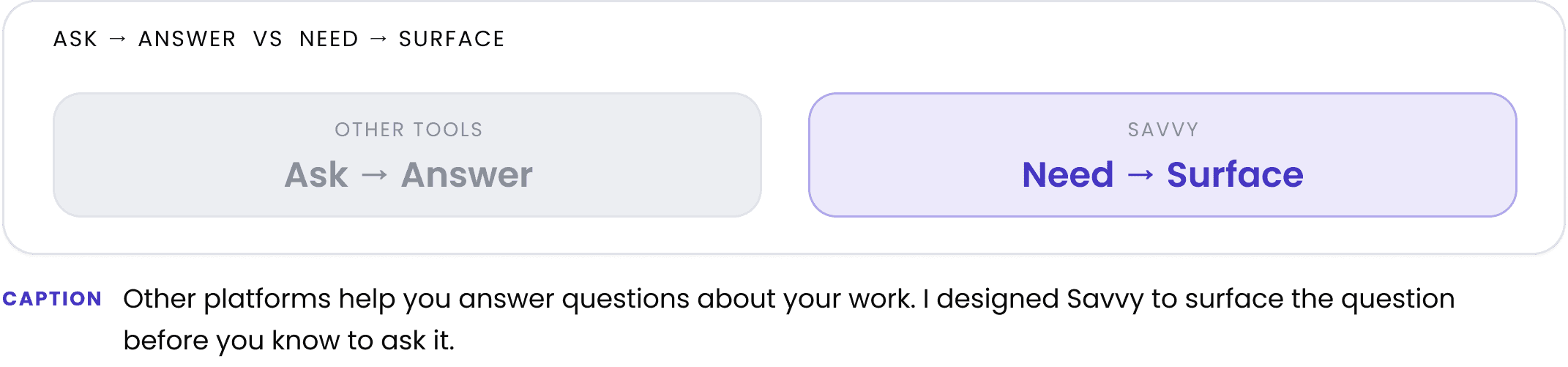
Work platforms already use AI to flag risk and answer prioritization questions when asked. Savvy's difference isn't a feature. It's when it speaks up.
Two numbers would tell me whether that's true.


